

Blog

Which Ford Truck is Best for You?

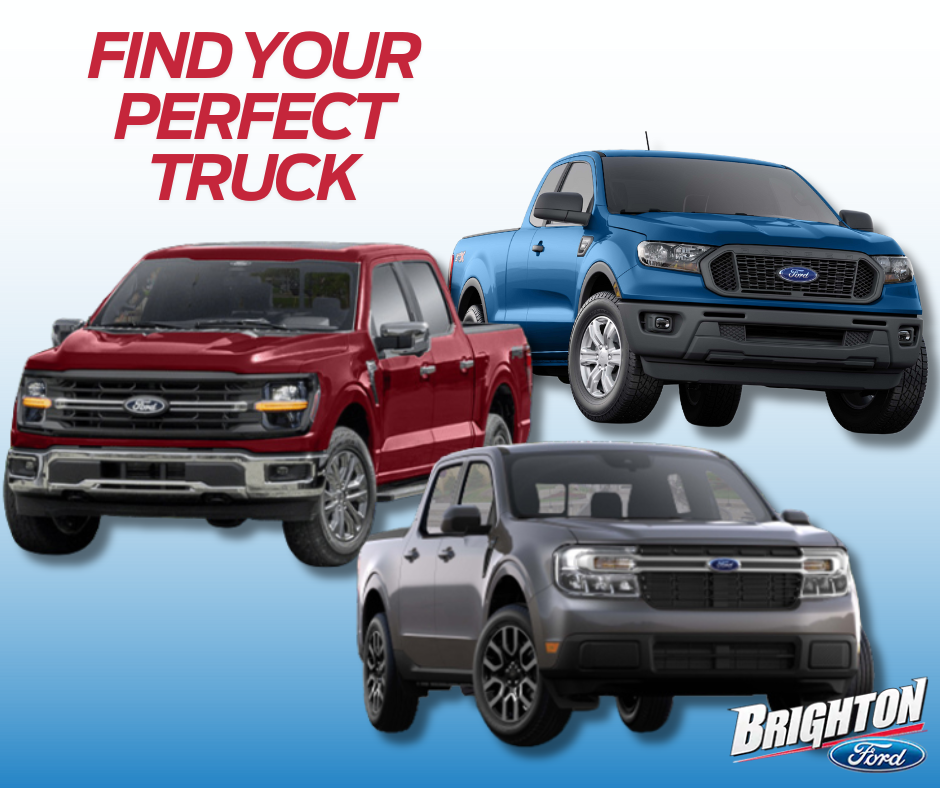
Buying a new truck for you or your business can be a big investment, which is why it’s so important to pick the truck that works best for you! Ford has a variety of models, trims, and configurations, that all offer something different. To help get you on the right track to finding your new ride, here’s a quick overview of a few popular models and a rundown of some of their key features.

Probably the most well known of the Ford trucks is the Ford F-150. The 2024 F-150 is a full size truck with a staggering variety of customizations and powertrains (including gas, hybrid, and EV) that can get you anywhere from 10-20 MPG city, and 16-26 MPG highway! With such a wide array of available features, this truck has the widest price range of all the trucks listed here, spanning anywhere from $38,000 to upwards of $85,000. There are three cab sizes for you to choose from (Regular Cab, SuperCab, and SuperCrew) as well as three bed sizes (5.5 feet, 6.5 feet, and 8.0 feet); and depending on which powertrain, cab size, and bed size you decide on, the F-150 has a max towing capability of 13,500 pounds, and max hauling of 2,445 pounds! All 2024 models have a 12” touchscreen display, and the F-150 has several trim levels including XL, STX, XLT, Tremor, Lariat, King Ranch, Platinum, and Raptor. Finally, the F-150 is incredibly highly rated in regards to safety! The NHTSA (National Highway Traffic Safety Administration) gave the F-150 a five-star rating for safety, and the IIHS (Insurance Institute for Highway Safety) gave the truck the Top Safety Pick award. There’s a reason the F-series trucks have been named the most popular truck in America for nearly 50 years!

Looking for something a little bit smaller? The 2024 Ford Ranger is a midsize truck that comes standard with an I-4 2.3 liter turbocharged engine, which can get 19-21/19-25 MPG city/highway. The upgraded option for an engine in the Ranger is a V6 2.7 liter twin-turbocharged, which can get you 16-18/18-23 MPG city/highway. As far as the cab goes, this truck offers two options; SuperCab, or SuperCrew, and in terms of bed length, the 2023 model has the option for a 5’ bed or a 6’ bed, whereas the 2024 model only offers the 5’ bed. Towing and hauling are a large factor as to why people choose to get a truck, which is why the Ranger offers a max towing capacity of 7,500 pounds and a max hauling capacity of 1,805 pounds. All 2024 Rangers come standard with a 10” infotainment system, with a 12” screen in the upgraded models. The Ford Ranger will run you anywhere from $32,000 to $50,000 depending on your choice of trim (XL, XLT, Lariat, and Ranger Raptor), engine, and other customizations, making it a great mid-priced, midsize truck!

More interested in a compact truck? Take a look at the 2024 Ford Maverick! The Maverick is a compact truck that comes standard with a 2.0 liter turbocharged, 4-cylinder engine that gets you 22-23/29-30 MPG city/highway, or you also have the option to upgrade the engine to a 2.5L 4-cylinder hybrid engine. The Maverick offers three trim levels; XL, XLT, and the Lariat, all of which have a four and a half foot bed. With the hybrid option, this truck has a towing capability of 2,000 pounds and a hauling capability of 1,500 pounds! There is also an optional 4K Tow Package with the standard turbocharged engine. With these different engine and trim options, the Maverick can run anywhere from $23,000 to upwards of $40,000!

We know that picking a new vehicle can be a big decision, so we want you to have as much information as possible! Do you have questions, or want to sit down with someone who knows the ins and outs of each of these trucks? Come on in to the dealership to chat with one of our incredible sales consultants, take a look at these trucks in person, and find the perfect fit for you!

Recommended Posts

Winter Emergency Supplies Blog

There’s an extra list of things to worry about when it comes to driving in the winter time. Most of us have seen (or been in) cars that get stuck in a snow bank or can’t get traction on an icy patch. And one of the worst feelings is leaving work at the end of the day, it’s already dark outside, and realizing that there are a couple of inches of snow and a layer of frost covering your windshield. So, with the winter weather moving in, now is the time to triple check that you have everything you need in case of an emergency! Here are a few things we find extra helpful! Windshield Scraper- This one seems pretty obvious, but it’s one of the worst things to be caught without! Small Shovel- If you have the space in your car, keeping a small shovel can be an absolute life-saver for digging out the space you need to get moving. Sand or Cat Litter- Sometimes, a little extra traction is all your tires need to get you moving again. Putting a little bit of sand or litter in front of your tires can often give you the boost you need! Jumper Cables- The last thing you want to be doing is sitting in a car with a dead battery, shivering while you wait for someone who has cables to get to you. Cell Phone Charger- In tandem with the jumper cables, it can be pretty hard to get help when your phone is out of battery! Boots- If you are someone who wears less protective foot wear, it might be helpful to keep a pair of boots in your vehicle. A pair of stilettos are fine in the office, but not very conducive to scraping your windshield or digging out your tires! Emergency Kit- If you are stuck beyond getting yourself out, it’s always smart to keep some emergency supplies to hold you over until help can make it out to you. Drinking Water and Snacks- We always hope that we won’t be stuck for long, but it’s even worse to be stuck for a while and to be hungry or thirsty. Blankets- In a situation where you can’t run the vehicle, it’s good to have at least a blanket or two to bundle up in! Extra Layers- Like with the blankets, it’s good to have extra socks, gloves, hats, scarves, jackets, or any other layers to keep warm, or layer up if you have to get out of your vehicle! First Aid Kit- This is a good one to keep in your vehicle at all times, just in case! Flashlight and Batteries- With the sun setting early in the evening, having a flashlight, and making sure it has the batteries to work can be super important. The best way to avoid an actual emergency is to be prepared, so take a few minutes to go over what you may need to keep safe and warm on the road this winter!

Closing the Year with Purpose: Our Partnership with LACASA

In this final week of the year, we are honored to close things out on a cheerful and humbling note by celebrating our long-standing partnership with our friends at LACASA Center, which serves survivors of child abuse, domestic violence, and sexual violence in Livingston County. This year, our team not only stepped up as presenting sponsor of the LACASA gala and volunteered on the gala committee and at the event, but also helped make possible the donation of a new transit van to support LACASA’s critical work in the community. Through our Home for Good campaign, we were able to support the creation of LACASA’s new “forever home” facility, which brings comprehensive shelter, advocacy, and counseling services together under one roof for survivors and their families.​ We are deeply proud of our team and leaders whose generosity, time, and commitment have helped make giving back to LACASA possible, and we remain grateful for the opportunity to stand alongside an organization that provides safety, dignity, and hope to more than 5,000 victims and their families each year.

EV Charging Times

When it comes to electric vehicles, a common question that gets asked is “How long does it take to charge?”, and the answer is it depends! Here we’ll break down the important things you’ll need to know to get charged up and ready to drive. Charger Level - A major factor in how long it’s going to take to charge your vehicle is the level of charger that you are using. Level 1 - These use a standard 3 prong socket, and standard 120V household power, and they are plugged directly into a wall socket. The power is dictated by the home’s wiring, and can add around 3 to 5 miles of range per hour of charging. Level 2 - These chargers have a 240V connection, and should be installed by a professional electrician. Adding about 25 miles of range per hour of charging, this is commonly used as a home charger because it is capable of completely charging a vehicle overnight. There are also tens of thousands of these available around the U.S. at public charging stations. Level 3 - In these chargers, the DC (direct current) conversion happens in the charging station rather than in your vehicle, which for you means quicker charging! Depending on the charger, a level 3 could add up to 100 miles of range in anywhere from an hour to just a few minutes. t’s also important to note that there are a lot of factors that can influence how quickly your vehicle charges, and how long it holds its charge. Take into consideration the size of your battery pack, the efficiency of your vehicle, and the weather (especially temperature)! Check out our Electric Vehicle page to learn more about how you can use the FordPass app to find and use for chargers all around the country! By: Skylar Deming, Marketing Associate